Pound families sharpen life skills with STEM-based community projects
May 8, 2026
Pound Middle School students and their families achieved STEM victories exploring community issues with virtual reality technology this spring.
Three Pound groups relied on their science, technology, engineering and math (STEM) knowledge to complete projects about smartphone usage, stray animal advocacy and affordable housing in Lincoln. They teamed up with the National Center for Families Learning (NCFL), BrainSTEM Edtech and the Nebraska Statewide Family Engagement Center for their ventures, which lasted for several months during the school year. They presented their findings at an evening showcase in Pound’s auditorium and lobby.
Seventh grader Aries said it was fun working with friends Noah and Rowan on their project. They examined the effects of smartphone usage on social and physical well-being. They asked people about their smartphone habits and if they thought they could go 24 hours without viewing their device. They then developed a “Digital Detox Plan” that included the slogan “Disconnect to Reconnect.”
“I really enjoyed the technology part, because I’m into coding and a lot of the technological stuff,” Aries said. “I also really enjoyed the challenge of this. I’m very into trying to solve problems, so it was a really good mix of those things.”


Students on all three teams worked with parents and teachers on the multi-generational endeavors. Aries, Noah and Rowan spent ten weeks with parents Jami, Jared and Ian on the projects. They also partnered with Pound math teacher April Schermann for guidance and support.
Jami said it was meaningful to share educational moments with her daughter and other team members. The group met twice in person and then coordinated their work over Zoom. She said the adults and students learned a lot from their time together.
“I would have questions, and the students would jump in right away and say, ‘Try this. Try that,’” Jami said. “It was really cool to have that participation with the parents and students and teachers.”
Schermann said she was also pleased with the family-based partnership. Every age group presented ideas that other team members had not thought about, which strengthened the final product.
“I think working together to achieve a common goal was one of the most important things about this,” Schermann said. “I love the multi-generational concept of everybody working together to identify a community problem and figuring out how to solve it. Then, we’re all able to celebrate together at the showcase tonight, which is a great way to end everything.”


Kara Mason of BrainSTEM and Tina Marsteller of NCFL helped expand the scope of that community engagement outside of Nebraska. They both traveled from Louisville, Ky., to celebrate with Pound families at the showcase.
Marsteller, a training specialist with NCFL, told the audience she was impressed with the initiative the Pound teams displayed. She also said the interaction between the group members enhanced the educational value.
“Family-based learning isn’t just about STEM, it’s actually something more,” Marsteller said. “As they work together, they discover things about themselves, they discover things about their parents, and they discover things about their educators. Some of the things that the students and educators said about what they learned about building relationships with one another were very profound. They really gained a lot from doing this.”
Mason is the chief operating officer of BrainSTEM Edtech, which helps K-12 schools develop immersive STEM curriculum and technology programs. She specializes in virtual reality and augmented reality integration projects, which fit perfectly with Pound’s goals. The VR architect turned the data she received from all three teams into computer-generated landscapes.
Aries, Noah and Rowan were excited when they saw a VR room including tables with people staring down at their smartphones. The second room featured people talking with each other after going through the “Digital Detox Plan” steps.
Mason said the Squires sharpened their research, teamwork, problem solving and communication skills by working together. Gus and Amirria joined forces with parents Calli and Jane and teacher Kelsey Wiemer to design small animal shelters for spots across Lincoln. Owab, Simon and Gunner partnered with parents Abdalrazig, Corey and Jamie and teacher Brian Berry on their project. They investigated architectural and systemic ways to create affordable housing options for Lincoln residents.
“This is just the tip of the iceberg,” Mason said. “All of these teams have put so much work into their research. They’ve worked outside of school and during lunch hours, so they were really passionate about these community challenges. Virtual reality is just a new and innovative way to show what they’ve learned.”

Schermann said the Squires also found out how to overcome challenges one step at a time.
“I think it’s been a good lesson for the students, because things didn’t always go right the first time they tried it,” Schermann said. “They’ve learned a little bit of patience and perseverance. They’ve discovered that when things don’t go right the first try, you keep working and you don’t give up.”
Marsteller said Pound provided a prime example of the impact STEM victories can have on everyone involved.
“When we think about family-based learning, we think about something that not only helps our schools, but it really carries over into the community,” Marsteller said. “The learning that they have done and the creativity that they have put into it has been very evident.”
Discover how computer science knowledge can broaden the educational horizons of LPS students.
Do you have a story idea? Share it with the LPS Communications Team by filling out this form!
Published: May 8, 2026, Updated: May 8, 2026
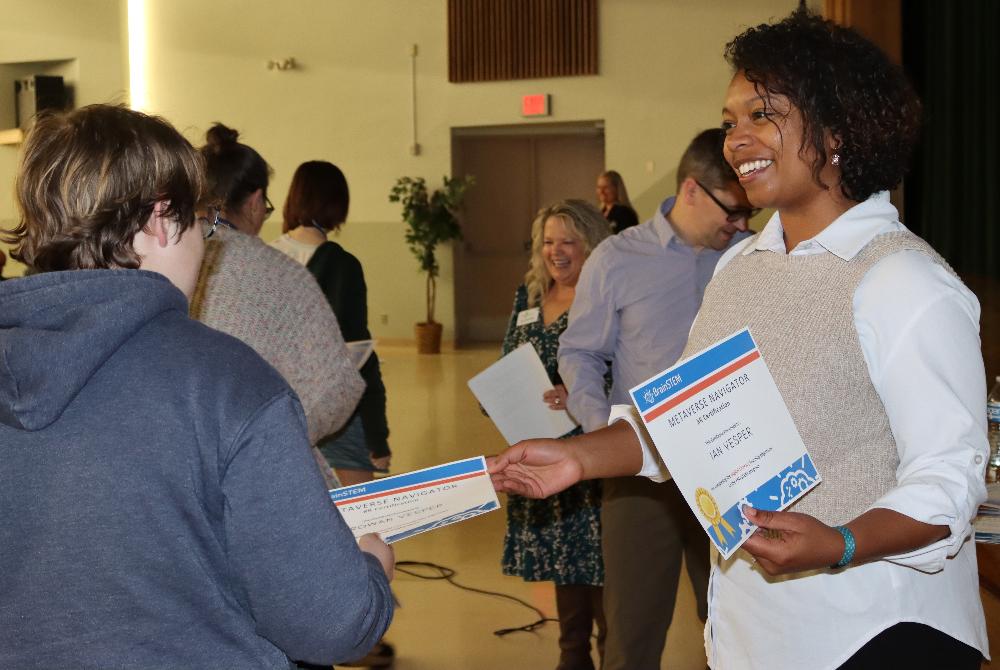
BrainSTEM Edtech Chief Operating Officer Kara Hudson smiles as she hands a certificate of achievement to a Pound Middle School student in the school auditorium. Hudson spoke at a STEM Night event that showcased three community projects by Pound students, families and teachers. They incorporated virtual reality technology in their projects.