Famous author Sandra Cisneros inspires students during Arts and Humanities visit
May 4, 2026
A world-famous author helped local students learn how the worlds of arts and humanities share strong academic links this spring.
Sandra Cisneros spoke about her lifetime of creative achievements during a visit to the Arts and Humanities (A&H) Focus Program campus. She provided insights about the way she designs stories and poems to students, who read her best-selling novel “The House on Mango Street” beforehand. Cisneros also illustrated how art and humanities topics can work together to form powerful lessons for people.
A&H students Gracyn and Cadence said they were impressed by what they heard. Cisneros explained how she refines her literature by applying different life experiences to it. Gracyn, a junior at Standing Bear High School, and Cadence, a sophomore at East High School, said that gave them confidence to continue pursuing their writing and artistic goals.


“Being able to hear someone that has a similar story was really inspiring,” Gracyn said. “And it kind of reassured me that what I was doing was the right thing for me to do, even if there were some people that would call it, like, unrealistic. So, it just felt really reassuring.”
“I feel like just the way that she writes in her beliefs are kind of, they all speak to everyone at A&H,” Cadence said. “We all relate to them in some way.”
A&H teachers Maggie Elsener and Tara Moore said it was important for students to learn how all arts and humanities topics are intertwined. Sophomores and juniors read “The House on Mango Street” in its entirety this semester, while the other two grades explored story excerpts as part of their broader English curriculum. They then wrote vignettes, created bookmarks and made experimental videos and films about the storyline.


“We really want students to understand that the world is not a siloed experience,” Elsener said. “One subject affects another throughout human experience.”
“One of the greatest opportunities our students receive in focus programs is experiential learning,” Moore said. “Engaging with visiting writers, filmmakers and artists allows students to see the creative process firsthand and recognize that meaningful work is shaped by real experiences and intentional time devoted to the craft.”
Moore and Elsener said they were excited when they received word about Cisneros’ visit, which was made possible through a partnership between Lincoln Public Schools and the Lincoln-based Linked2Literacy non-profit program. Cisneros has written multiple novels, stories, poetry collections, picture books and personal essays that have been translated into 25 languages.
One of her most famous works is “The House on Mango Street,” which was first published in 1984. It has sold more than eight million copies and has recently been turned into an opera.

Cadence said Cisneros helped her become more aware of the similarities between penning stories and producing visual artworks. Writers transform texts with their pencils and keyboards many times before the final version is ready to publish. The same is true for artists, who often go through multiple attempts before displaying their work to the public.
“There was so much behind it that I didn’t understand before, because I was just looking at it as, ‘Oh, this is perfect writing’ and things like that,” Cadence said. “And so, it’s that art, like humans, isn’t perfect. There’s always going to be a stumble. There’s always going to be drafts, no matter how many drafts.”
Students also discovered how humanities subjects like history and culture can impact pieces of art. Cisneros based “The House on Mango Street” both on her own childhood experiences in Chicago and later stories from her Chicago students.
She relied on her personal history again when the opportunity arose to adapt the book into an opera. Her mother had borrowed opera records from the Chicago Public Library to play at home while she was growing up, and Cisneros remembered how much joy they brought to everyone listening.
“The arts are inextricably linked, as the arts are part of the humanities, and art is often created based on what is happening currently, what has happened in history, philosophy, literature, etc.,” Elsener said. “They are not separate entities and we emphasize this as part of our program.”
Gracyn said Cisneros gave her a valuable long-term perspective as well. She told students that life, like all forms of art, is a continual journey.
“At this point in my life, I feel like I kind of worry sometimes that I’m supposed to have it all figured out, you know?” Gracyn said. “But to be able to sit there and hear her talk about, ‘I’m 71 and I’m still figuring out who I want to be, and I’m not, like, the exact person I want to be, not the exact writer I want to be.’ That was, I don’t know, I’m doing this hand to my heart thing a lot, because it really just hit where I needed to hear it.”
Moore said those uplifting moments reinforced why arts and humanities lessons are so essential for students to explore.
“It was incredibly meaningful to watch students make authentic connections between her words, her creative process and their own lives,” Moore said. “There was a real sense of curiosity and wonder in the room as they engaged with her ideas and asked thoughtful questions. I know this is an experience that will stay with them.”
Explore how to customize your high school experience with the Arts and Humanities Focus Program.
Do you have a story idea? Share it with the LPS Communications Team by filling out this form!
Published: May 4, 2026, Updated: May 4, 2026
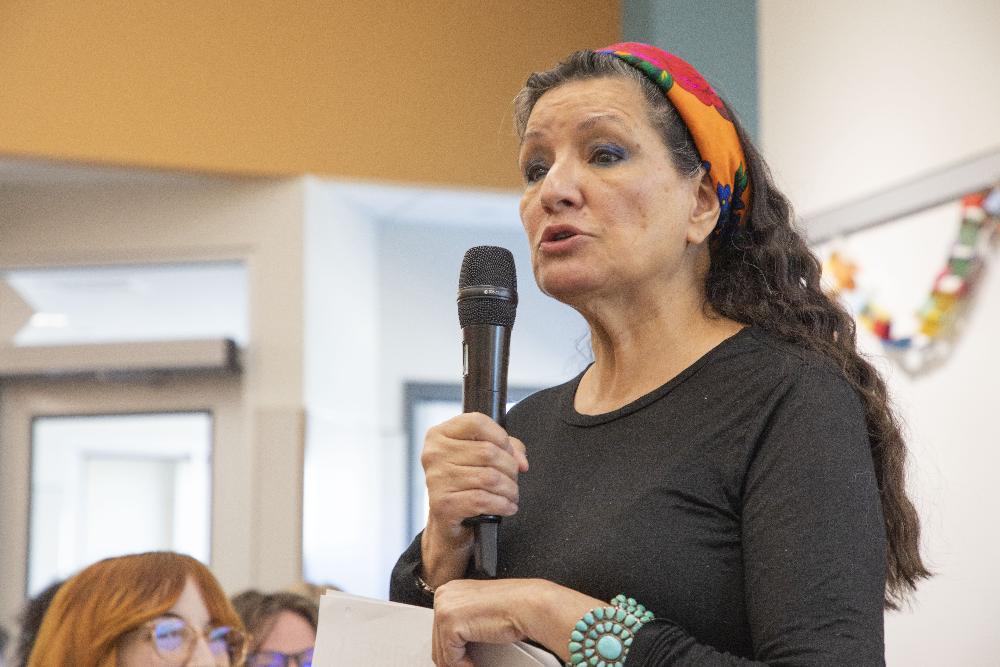
World-famous author Sandra Cisneros speaks to Arts and Humanities Focus Program students this spring. Cisneros visited with students about her distinguished writing career.