Links use analytical skills to argue for an A
March 6, 2026
If you had to convince your high school English teacher to give you an A on an assignment, how would you go about making that argument?
Lincoln High students answered that question this winter by completing an “Argue for an A” project in their Advanced Placement Language and Composition class. They showcased the rhetorical and analytical skills they have learned during the yearlong course. They could use either logical or emotional reasoning to explain why their posters should have an ‘A’ attached to them.
Karen and Lola both took straightforward routes in stating their cases to teacher Nick Bihm. Karen listed why an A would help her become a lawyer on her poster entitled “The Future of My Life is in Your Hands, Mr. Bihm.” Lola employed a similar strategy, as she told Bihm that getting an A would let her maintain the grades she needs to become a veterinarian. Both juniors said they had fun sharpening their critical thinking talents on their projects.
“It was very open-ended, so it was a little scary at first, but I liked the assignment,” Lola said. “I honestly wish I had more assignments like it.”
“I enjoyed how it challenged your creativity,” Karen said. “It gave people different ways for them to think about how they could argue for their A.”


Other students took more unconventional paths on their persuasive journeys. Josephine, a junior, remembered that her older sister had received an A on the same assignment last year. She used that fact to urge Bihm to give her an identical grade.
“My reasoning was that I’m smarter and more like my teacher than she is,” Josephine said. “I said that I deserve an A because, obviously, I’m a better sibling, so that was really fun.”
Bihm, who previously taught in Louisiana for ten years, brought the “Argue for an A” project with him to Lincoln High when he began leading English classes there two years ago. He said it has been fun to watch students use their own life experiences to design their posters.
Some Links listed their previous academic achievements as evidence of why they should get another A, while others appealed to Bihm’s sense of compassion for their futures. Several students drew kitten astronauts on their posters to remind Bihm that they had paid attention in class. The star-bound felines were symbols of the speaker, purpose, audience, context, evidence, choices, appeals and tone (SPACE CAT) components of a successful persuasive argument.
“I’ve seen students be really encouraged by, ‘Oh, I’m going to manipulate him to get my A,’ or ‘I’m going to guilt him into it,’ or something like that,” Bihm said. “They kind of energize themselves when they’re in that brainstorming process, which I really like to see.”


Josephine said innovative tips like the SPACE CAT acronym had helped her soak up AP Language and Composition fundamentals. She absorbed those lessons even more while thinking of creative ways to craft her poster.
“I think it broke it down in a way that was more understandable to me,” Josephine said. “Sitting down and getting taught stuff is one thing, but doing a poster, it adds that level of interest in it. It helped me a lot.”
After the Links completed their posters, they taped them to several walls in the hallway for a poster gallery walk. Each student analyzed the rhetorical and visual choices their classmates made on their projects. They then listed reasons why the other posters were “academically excellent” and if they thought Bihm should give their classmates an A.
In addition to teaching students how to look for airtight arguments, the poster gallery walk also showed them that there were many ways to arrive at the same A-worthy destination.
“I liked the drawings that everyone made,” Karen said. “It was fun to see their own creativity, because they did things that I didn’t think of myself.”


Lola said the project had helped her become closer with her classmates, too. Many Links used personal stories as threads for their arguments, which increased the chances for connection and community in the room.
“It’s fun to talk to your peers and see what they’re going through in their own lives,” Lola said. “A lot of the things that I read on the posters, I never knew about those people. It was really interesting, honestly.”
After students returned to the classroom, they took a card from Bihm, folded it in half and wrote a note of praise to someone who they felt had done a good job. The final activity taught them about the importance of including encouragement in their daily school routines.
Lola said the course was preparing her well for the upcoming AP exam. She felt it was giving all of the Links more confidence in the three A’s of analysis, arguments and articulation.
“The entire class is really helpful with making students understand how to back up their claims, to back up what they’re saying in any facet, talking about anything,” Lola said. “They’re able to back up what they’re saying because we’re learning all of these things.”
Interested in how English is taught at LPS middle and high schools? Explore our secondary English Language Arts curriculum.
Do you have a story idea? Share it with the LPS Communications Team by filling out this form!
Published: March 6, 2026, Updated: March 6, 2026
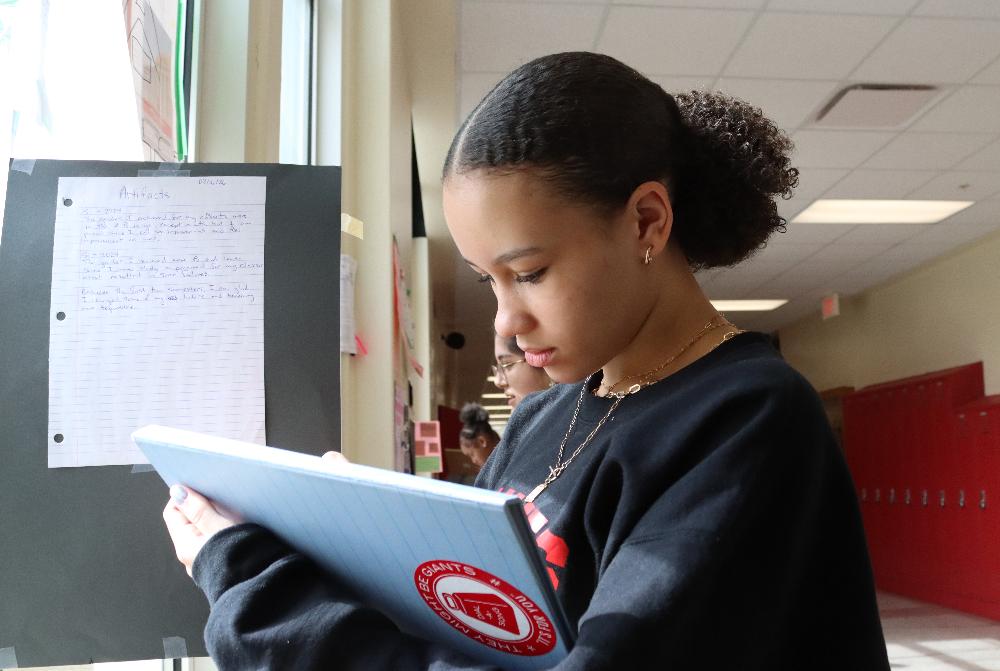
Lincoln High junior Josephine writes down comments as she looks at part of a poster that is hanging in a hallway. She and other Advanced Placement Language and Composition classmates took part in an Argue for an A assignment. They could use either logical or emotional lines of reasoning to say why their posters should have an 'A' attached to them.