Links build incubator of ideas in new STARLAB research class
February 12, 2026
Lincoln High students are turning one of their classrooms into an incubator of scientific and engineering research ideas this year.
Alex, Jack, Smart, Lucas and Taw are the inaugural members of a new STARLAB class that is giving them firsthand knowledge of the research-and-development process. The five STARLAB (Science Through Advanced Research Learning Application and Building) students are expanding their educational frontiers with yearlong investigations on topics of their own choosing. The goal is for them to experience how authentic science and engineering data collection is conducted after high school.
Jack and Alex said they have enjoyed their STARLAB adventures. Jack is recycling plastic bottles into spools of filament for 3D printer projects. Alex is creating a computerized aiming system that will automatically focus a telescope on a desired celestial object, like a planet or star.
“I think having experience working on my own project will be helpful,” Jack said. “I’m looking to go into engineering, so I feel like this is a nice stepping stone just to get acquainted with how it works.”
“Overall, it’s been a class that has helped me learn a lot and has honestly prepared me a lot for what I want to do in college,” Alex said.


Lincoln High science teacher Brian Hageman said he has been impressed with how the Links have handled their independent tasks. They have spent the school year generating original project ideas, conducting experiments, refining their design strategies, analyzing real data and stretching their critical thinking skills. The science, technology, engineering and math (STEM) activities take the place of daily textbook lessons during class time.
“It is different than every science course that students have ever taken, but it takes a different kind of student,” Hageman said. “It takes a lot of self-motivation, a lot of drive, a lot of agency. If STEM is your sort of direction in life, this is dipping your toe into the pool for the first time, kind of seeing what those waters are like.”
Hageman drew from his own professional background when he wrote the STARLAB curriculum. He began his scientific career as an astrophysics researcher at the University of Southern California, and he later became an organic chemistry researcher in New York City. The South Dakota native began teaching at Lincoln High in 2023 as a way to encourage students to consider entering scientific and engineering fields.
Hageman said one of the course’s top purposes is to cultivate skills like persistence, resilience, problem solving and communication. The independent structure means students are responsible for collecting information, setting up meetings, writing research summaries and reaching project milestones.
“You often hear you get out of something what you put into it,” Hageman said. “STARLAB is exactly that, because as deep as you want to go, as far as you want to take this project, I am here to facilitate, but it’s up to you and how much you want to devote to this.”

The Links have taken those words to heart. All five have created glossy professional-grade posters outlining their goals and evaluation metrics, and several have connected with University of Nebraska-Lincoln professors for their projects. They have also scoured scientific literature to see how previous breakthroughs can help them.
Alex’s telescope venture includes engineering, math, astronomy and computer science components, and he has chosen to learn computer-aided drafting (CAD) programs this year. He has balanced his STARLAB efforts with a full schedule that includes band, choir and theater technical crew activities.
Alex said the course is offering him a preview of his upcoming college calendar. He is planning to major in either electrical or aerospace engineering.
“Working on this project has taught me a lot about the time and effort that goes into an engineering project,” Alex said.
Jack said STARLAB is making a present-day difference as well. He noticed he was using a large amount of regular filament for his home-based 3D printing projects, and he and Hageman began discussing possible solutions in class. They felt recycling two-liter plastic bottles into filament strands made sense from environmental, economic and engineering standpoints.
“One of the things we noticed was that there’s a lot of plastic bottles around the school, and just in life in general, there’s a lot of plastic bottles thrown away,” Jack said. “The hope is that I can use plastic bottles to not only reduce the waste they make, but to open up opportunities for 3D printing.”
Hageman said life lessons like time management, initiative and creativity are centerpieces of the course’s grading system.
“It’s different in the sense that it’s not like a test where your answer is right or wrong; it is you are going through a process,” Hageman said. “Are you hitting every milestone that you should in that process? While the rubric might not look the same as it does for AP Physics, it is still a rigorous, evidence-based rubric.”
Alex said he is looking forward to watching his telescope project leave the STARLAB incubator as an engineering success story.
“Being able to do all this work over the course of a year, and then being able to see it come to fruition, I’m so excited,” Alex said. “I feel like it will be a really good feeling.”
Discover how LPS science classes like STARLAB are giving students the tools they need to shine in their future careers.
Do you have a story idea? Share it with the LPS Communications Team by filling out this form!
Published: February 12, 2026, Updated: February 13, 2026
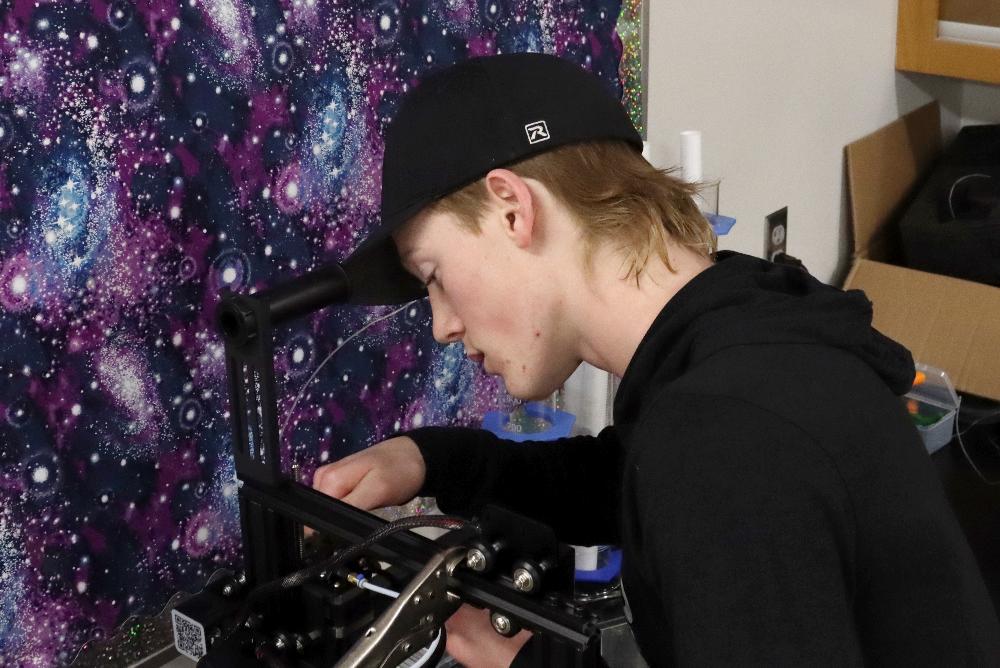
Lincoln High senior Jack works on a 3D printer in a science classroom this winter. He is one of five Links who are taking a new STARLAB course. The class is helping them learn how science and engineering research takes place in professional settings.